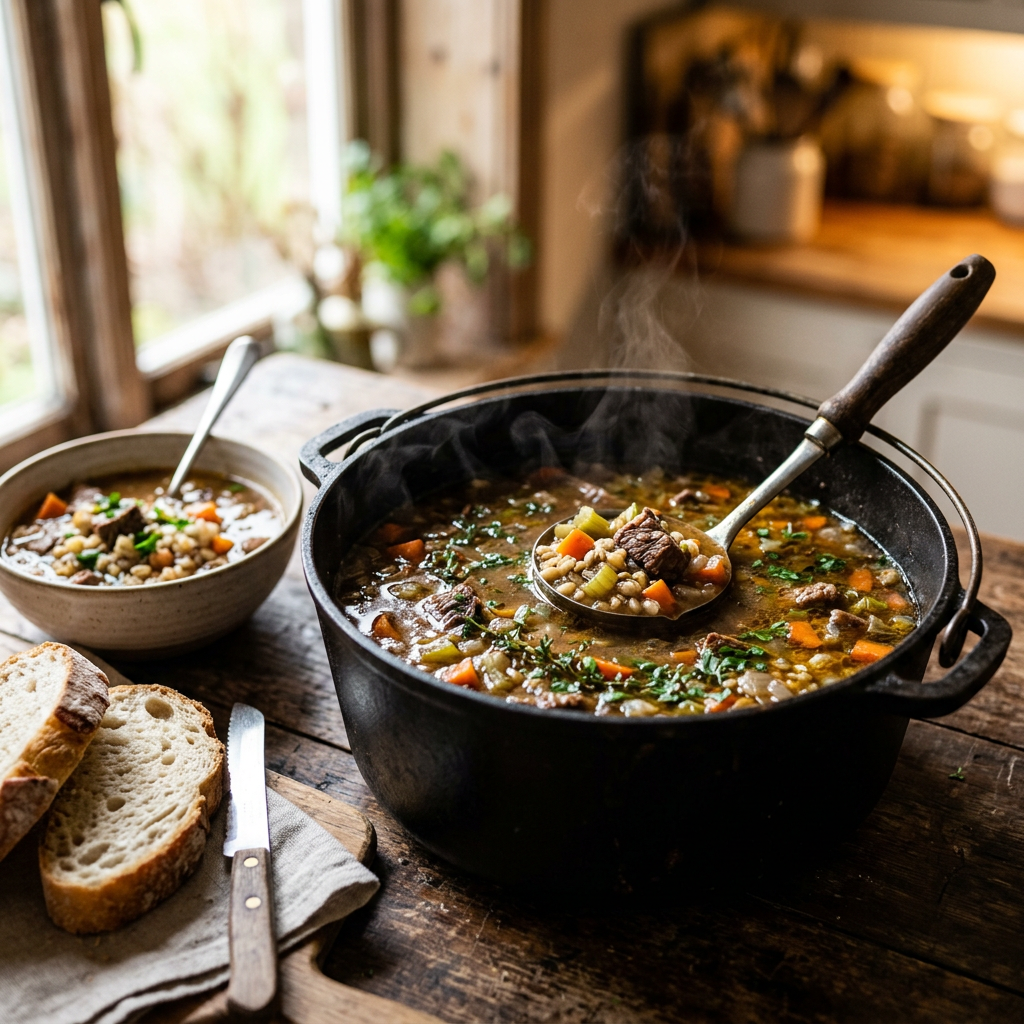
There’s something quietly wonderful about a pot that mostly takes care of itself. You do twenty-five minutes of real work up front (some chopping, some browning, a little scraping), and then the lid goes on and the kitchen takes over. Outside it’s gray November in Casper, the wind is doing its usual thing, and inside there’s a Dutch oven ticking away on the back burner, making the whole house smell like Sunday even if it’s a Wednesday.
That’s what beef and barley soup is for me. It’s not fancy. It doesn’t need a special trip to the store. It’s chuck roast, a few vegetables, a box of broth, and a cup of a grain that a lot of us only think about once a year. But when it’s done right, it’s one of the most satisfying bowls of food I know, and it’s the pot I reach for when the forecast turns and I want dinner handled for the next couple of days.
This version is written for cooking at elevation, since I’m at about 5,150 feet here and that changes a few things. If you’re at sea level, it all still works; you’ll just probably finish a little sooner.
Why Beef and Barley Works So Well
Beef and barley is one of those combinations that sits right on the line between soup and stew. A stew is usually thick, chunky, and spoon-standing; this is brothier than that, but with enough beef and grain in every spoonful that it eats like a full meal. You don’t need a sandwich on the side to feel like you had dinner (though I’ll make a case for biscuits later).
The barley is what makes it. It’s chewy and nutty, it soaks up the beefy broth, and it releases a little starch as it cooks, which gives the soup a bit of body without any flour or cream. Pair that with chuck that has gone from tough to tender over a long, gentle simmer, plus the sweetness of carrots and onion and the earthiness of mushrooms, and you get something deep and comforting that tastes like it took more effort than it did.
If you’ve made my Dutch Oven Pot Roast, the technique here will feel familiar: brown the beef well, build flavor in the same pot, then let low heat and time do the heavy lifting. This is basically that idea, cut into spoon-sized pieces and stretched with broth and grain.
High-Altitude Notes (Read This If You Live Up High)
When we moved from outside St. Louis to Casper in 2022, I figured cooking was cooking. Wyoming had other ideas. The biggest thing to understand is that water doesn’t get as hot up here before it boils.
According to Colorado State University Extension’s High Altitude Food Preparation guide, water boils at roughly 203°F at 5,000 feet, compared to 212°F at sea level. The same guide notes that liquids evaporate faster at higher elevations.
For a soup like this, that has a couple of reasonable consequences:
- Things simmered in liquid tend to cook a bit slower. Your simmer is happening at a lower temperature than it would at sea level, so the beef may take longer to turn tender, and the barley may need extra time too.
- Your pot can lose liquid faster. Between the faster evaporation and the barley drinking up broth, it’s smart to keep an extra cup or two of broth (or water) nearby.
That’s why the times in this recipe are ranges, not promises. The best advice I can give, at any altitude, is to cook to tenderness, not the clock. Taste a piece of beef. Bite a few grains of barley. When they’re right, it’s done.
The Ingredients, and Why Each One Is There
Beef Chuck
Chuck roast is the move here. It comes from the shoulder, it has plenty of fat and connective tissue, and that’s exactly what you want for a long simmer. Lean cuts tend to dry out and get stringy in soup; chuck breaks down and turns silky. Buy a boneless chuck roast and cut it into roughly 1-inch cubes yourself. Pre-cut “stew meat” can work, but it’s often a mix of different cuts that cook at different rates, and the pieces are all over the place in size.
If you keep a chest freezer stocked with meat (I wrote about the game side of that in Field to Freezer), a chuck roast is a great thing to pull out for this. Just thaw it in the fridge first so it browns properly.
Pearl Barley vs. Hulled Barley
You’ll mostly see two kinds of barley at the store:
- Pearl barley has had its outer hull and bran polished off. It cooks faster and softer, typically somewhere around 25 to 40 minutes simmering in soup. This is what the recipe is written for.
- Hulled barley keeps more of its bran, so it’s chewier and takes longer, typically up to an hour or more. It’s great, but if you use it, add it earlier and plan for the extra time.
Either way, check the package. Brands vary, and the package directions are a better guide than any number I give you. I like to rinse pearl barley quickly in a strainer before it goes in, just to wash off loose starch and any dust.
If your store’s selection is thin, Bob’s Red Mill pearl barley is an easy one to find online. The listing I found is a 4-pack of 30-ounce bags, which is a lot of barley, but it keeps in the pantry and covers a whole winter of soup. (Affiliate link; I may earn a small commission if you buy, at no extra cost to you.)
The Aromatics
Onion, carrot, and celery are the classic base, and they each pull their weight: the onion brings sweetness and depth, the carrots add color and a little more sweetness, and the celery gives a savory, slightly grassy backbone. Garlic goes in near the end of the sauté so it doesn’t scorch. Cremini mushrooms aren’t strictly traditional in every version, but they add a meaty, earthy flavor that makes the broth taste richer. If you’re not a mushroom household, leave them out and the soup will still be good.
Tomato Paste and Worcestershire
These two are the quiet workhorses. Two tablespoons of tomato paste, cooked in the pot for a minute or two until it darkens, adds savory depth without making the soup taste like tomatoes. Worcestershire sauce brings a salty, tangy, almost-fermented richness that makes beef taste more like beef. You won’t pick either one out in the final bowl, but you’d miss them if they were gone.
The Vinegar Finish
This one is optional, but I’d encourage you to try it. A tablespoon of balsamic or red wine vinegar stirred in at the very end brightens everything up. Long-simmered soups can taste a little flat and heavy, and a small splash of acid wakes them back up. Add it, stir, and taste. If the soup suddenly tastes more like itself, that’s the vinegar doing its job.
Technique: Where the Flavor Actually Comes From
Brown the Beef, in Batches
This is the step people rush, and it’s the one that matters most. Pat the beef cubes dry with paper towels, season them, and brown them in hot oil in a few batches. If you crowd the pot, the meat steams instead of browns, and you lose most of that deep, roasty flavor. You’re looking for a real brown crust on at least a couple of sides of each cube. It doesn’t need to be cooked through; it’s going to simmer for a long time.
Use the Fond
After browning, the bottom of your Dutch oven will be coated in dark brown bits. That’s fond, and it’s pure flavor. The vegetables go into that same pot, and their moisture starts to loosen it. Then, after the tomato paste cooks, a splash of broth and a wooden spoon will lift the rest of it right off the bottom. Scrape well. Everything stuck to that pot belongs in the soup.
Simmer Gently
Once the broth goes in, bring it up to a boil, then turn it down so you see small, lazy bubbles breaking the surface. A hard, rolling boil tends to toughen meat and break vegetables down to mush. Cover the pot and let the beef go for roughly 1 hour 15 minutes to 1 hour 45 minutes, until it’s nearly tender. At elevation, lean toward the longer end and check it.
Add the Barley at the Right Time
Barley goes in after the beef is mostly tender, not at the start. If you add pearl barley at the beginning, it’ll be overcooked and blown out by the time the beef is ready. Stir it in, keep the soup at a gentle simmer, and cook another 30 to 45 minutes until the grains are tender but still have a little chew. Stir now and then so nothing sticks to the bottom, and add more broth or water if it’s getting too thick.
Troubleshooting
The Beef Is Still Tough
It almost always just needs more time. Chuck goes through a stage where it’s cooked but still firm and chewy, and it only turns tender once that connective tissue has had long enough to break down. Keep simmering, covered, and check every 15 minutes or so. If the barley is already in and getting soft, you can fish out the beef, or just accept slightly softer barley in exchange for tender meat. Tender beef wins that trade.
The Barley Is Mushy
Usually it either went in too early or cooked too long. Next time, add it later and start checking at the low end of the time range. Also keep in mind that barley keeps absorbing liquid after the heat is off, so it’ll be softer tomorrow than it is tonight. That’s normal.
The Soup Is Too Thick
Add hot broth or water a half cup at a time until it looks right, then re-season. This happens a lot, especially at altitude and especially with leftovers. America’s Test Kitchen makes the same point in their beef-barley soup notes: the barley keeps soaking up liquid, so the soup thickens as it sits and needs thinning when you reheat.
The Soup Is Too Thin
Simmer it uncovered for a bit so some liquid cooks off, or let the barley go a few more minutes to release a little more starch. You can also mash a ladleful of barley and vegetables against the side of the pot and stir it back in.
It Tastes Bland
Nine times out of ten, it needs salt. Low-sodium broth is great because it lets you control the seasoning, but it also means you’ll probably need to add more salt at the end than you’d expect. Add a little, stir, taste, repeat. If it’s salted properly and still tastes flat, that’s when the vinegar comes in. A little extra Worcestershire can help, too.
Wyoming Has a Barley Story
One of the things I’ve enjoyed since moving here is learning what actually grows in this state, and barley turned out to be part of the picture. According to USDA’s National Agricultural Statistics Service, in its Wyoming small grains report from September 30, 2024, Wyoming growers seeded 74,000 acres of barley in 2024 and harvested about 51,000 acres for grain, with a state-record yield of 112 bushels per acre.
A Montana State University policy paper on the region’s barley reports that most Wyoming barley is grown under irrigation, and that about 65% of the state’s planted barley acres (averaged over 2007 to 2016) were in Park, Big Horn, and Washakie counties, up in the Bighorn Basin. I can’t promise the bag of barley in your pantry came from there, but it’s nice to know this grain isn’t a stranger to Wyoming.
How to Serve It
Ladle it into big bowls, scatter some chopped parsley on top, and crack a little black pepper over it. That’s really all it needs. A loaf of crusty bread is great for dragging through the bottom of the bowl, but my favorite partner is a batch of High-Altitude Buttermilk Biscuits. They come together while the barley simmers, and they’re very good at soaking up broth.
A simple green salad with a sharp vinaigrette balances out the richness if you want something fresh on the table. And since this lands on Veterans Day this year, if you’re looking for something warm to put in front of the people you’re spending the day with, this is a pretty good candidate.
Storage and Reheating
This soup makes plenty, and it’s great for leftovers, but a big pot of soup takes some care to cool and store safely. Here’s what the USDA Food Safety and Inspection Service says on its leftovers and food safety page:
- Refrigerate within 2 hours of cooking (within 1 hour if the temperature is above 90°F).
- Cool it quickly by dividing a large pot into smaller, shallow containers rather than putting the whole Dutch oven in the fridge.
- Fridge: eat leftovers within 3 to 4 days.
- Freezer: frozen leftovers are best quality within about 3 to 4 months.
- Reheat to 165°F, and FSIS specifically says to bring soups and gravies to a rolling boil when reheating.
Expect the soup to be noticeably thicker after a night in the fridge, since the barley keeps absorbing liquid. When you reheat, add broth or water a little at a time until it’s soup again, then taste and adjust the salt.
Beef and barley soup can be frozen, but expect the barley to soften further once it’s thawed and reheated. If you know you’re making a batch mostly for the freezer, one option is to cook the barley a few minutes less than you normally would.
Dutch Oven Beef and Barley Soup
Yield: 6 to 8 servings
Prep Time: 25 minutes
Cook Time: about 2 1/2 to 3 hours (cook to tenderness)
Total Time: about 3 hours
Ingredients
- 2 pounds boneless beef chuck roast, cut into 1-inch cubes
- 2 tablespoons neutral oil (vegetable, canola, or avocado)
- 1 teaspoon kosher salt, plus more to taste
- 1/2 teaspoon black pepper
- 1 large yellow onion, diced
- 3 carrots, sliced
- 3 celery ribs, sliced
- 8 ounces cremini mushrooms, quartered
- 4 cloves garlic, minced
- 2 tablespoons tomato paste
- 1 tablespoon Worcestershire sauce
- 2 bay leaves
- 1 teaspoon dried thyme
- 8 cups low-sodium beef broth, plus 1 to 2 cups extra broth or water as needed
- 3/4 cup pearl barley, rinsed
- 1 tablespoon balsamic or red wine vinegar (optional)
- Chopped fresh parsley, for serving
Instructions
- Season the beef. Pat the beef cubes dry with paper towels. Season with the 1 teaspoon kosher salt and 1/2 teaspoon black pepper.
- Brown in batches. Heat the oil in a large Dutch oven over medium-high heat until it shimmers. Add about a third of the beef in a single layer without crowding and brown well on at least two sides, 4 to 6 minutes per batch. Move browned beef to a plate and repeat with the rest.
- Sauté the vegetables. Lower the heat to medium. Add the onion, carrots, celery, and mushrooms to the pot and cook, stirring often and scraping up the browned bits, until the onion softens and the mushrooms release their liquid, about 6 to 8 minutes. Add the garlic and cook about 30 seconds, until fragrant.
- Cook the tomato paste. Stir in the tomato paste and cook 1 to 2 minutes, until it darkens slightly.
- Deglaze. Pour in a splash of the broth (about 1/2 cup) and scrape the bottom of the pot thoroughly with a wooden spoon to lift all the fond.
- Simmer the beef. Return the beef and any juices to the pot. Add the remaining broth from the 8 cups, the Worcestershire, bay leaves, and thyme. Bring to a boil, then reduce to a gentle simmer. Cover and cook until the beef is nearly tender, about 1 hour 15 minutes to 1 hour 45 minutes. Stir occasionally. At higher elevations, expect the longer end of the range or beyond.
- Add the barley. Stir in the rinsed pearl barley. Simmer, partially covered, stirring now and then, until the barley is tender and the beef is fully tender, about 30 to 45 minutes. Follow your barley package for guidance. Add extra broth or water as needed if the soup gets too thick.
- Finish. Remove the bay leaves. If you like, let the soup rest off the heat for about 10 minutes and skim off any fat from the surface. Stir in the vinegar, if using. Taste and adjust with more salt and pepper.
- Serve. Ladle into bowls and top with chopped parsley.
Recipe Notes
- Cook to tenderness, not the clock. At altitude, water boils at a lower temperature and liquid evaporates faster, so simmering can take longer and you may need extra broth. Check the beef and barley, not the timer.
- Hulled barley: It takes longer than pearl barley (typically up to an hour or more). Add it earlier in the beef’s simmer and follow the package directions.
- Wild game version: Venison or elk can stand in for the beef. Game is generally leaner than chuck, so it benefits from a gentle simmer and checking for tenderness along the way. For a full game-focused recipe, see my Dutch Oven Venison Stew.
- Oven method: After step 6 brings the pot to a boil, you can cover it and move it to a 325°F oven to simmer the beef instead of using the stovetop. Return it to the stovetop to add and cook the barley so you can keep an eye on the liquid. Timing will vary, so check for tenderness.
- Slow cooker: Do the browning and sauté steps in a skillet or Dutch oven first, then transfer everything to a slow cooker. Because slow cookers vary a lot and barley can turn soft quickly, add the barley later in the cooking and check it often. I’d treat this as a starting point rather than a tested method.
- Leftovers: The soup thickens as it sits. Thin with broth or water when reheating, bring to a rolling boil, and re-season.
If you make this, I’d love to see how it turned out. Tag @wyofood or come say hi on the Wyo Food Facebook page, and let me know what elevation you’re cooking at and how long your pot took. It helps everybody else up here plan theirs.
— Sean